
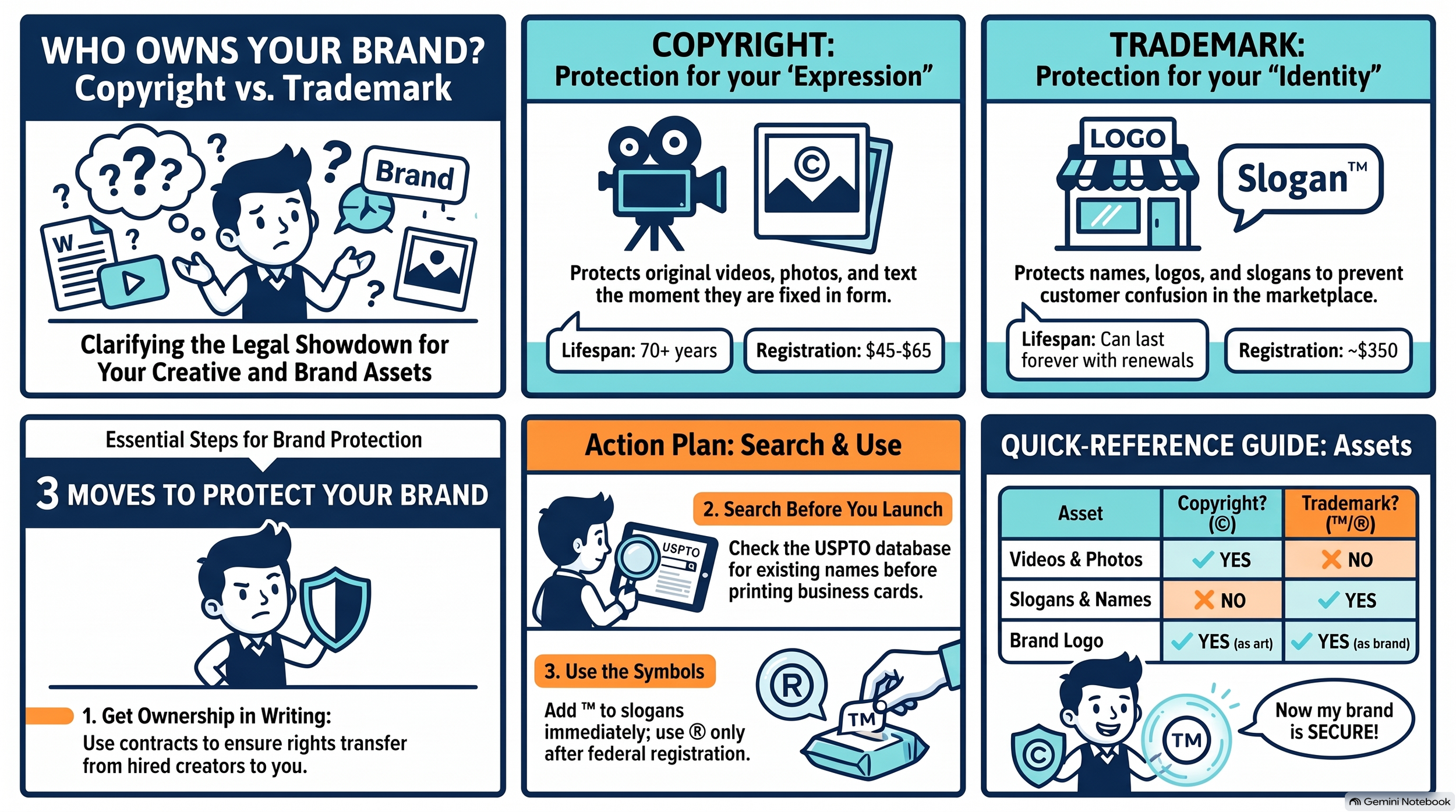
You spent weeks on your logo. Your promo video looks sharp. Your slogan sticks. Now ask yourself one question: who owns it?
Most small business owners can't answer that. They mix up copyright and trademark, or skip both. Then a copycat shows up, and the fight costs more than the protection ever would have.
This guide breaks it down in plain terms. You'll know what each one protects, what it costs, and what to do this week.
First, Copywriting Is Not Copyright.
They sound alike. They mean different things.
Copywriting is the craft of writing words that sell. Ads, captions, website headlines, email subject lines.
Copyright is the legal right that protects creative work, including that copy.
A copywriter writes it. Copyright protects it. Got it? Good. Let's move.
Copyright Protects the Work You Create.
Copyright covers original creative work once it exists in a fixed form. Think videos, photos, illustrations, music, book text, website copy, animations, and social posts.
What it does:
Stops others from copying, sharing, or remixing your work without permission.
When it starts: The moment you create the work. No paperwork required.
Why register anyway: In the U.S., you need registration to sue. It also unlocks statutory damages. Online filing runs about $45 to $65 per work.
How long it lasts: The creator's life plus 70 years. Work made for hire lasts 95 years from publication.
Symbol: ©
One catch: copyright protects the expression, not the idea. Your video about morning routines is protected. The idea of a morning routine video is not.
Trademark Protects Your Brand Identity.
Trademarks cover names, logos, slogans, and even sounds that tell customers who you are. It keeps competitors from confusing your audience.
What it does:
Stops others from using a similar mark for similar products or services.
When it starts:
Common-law rights kick in once you use the mark in business, but only in the area where you operate.
Why register:
Federal registration with the USPTO gives you nationwide protection and legal muscle. Expect about $350 per class of goods or services.
How long it lasts:
Forever, as long as you keep using it and file your renewals.
Symbols:
Use ™ any time. Use ® only after registration. Using ® without it can get you in legal trouble.
The key word is confusion. A bakery and a law firm can share a name. Two bakeries in the same market can't.
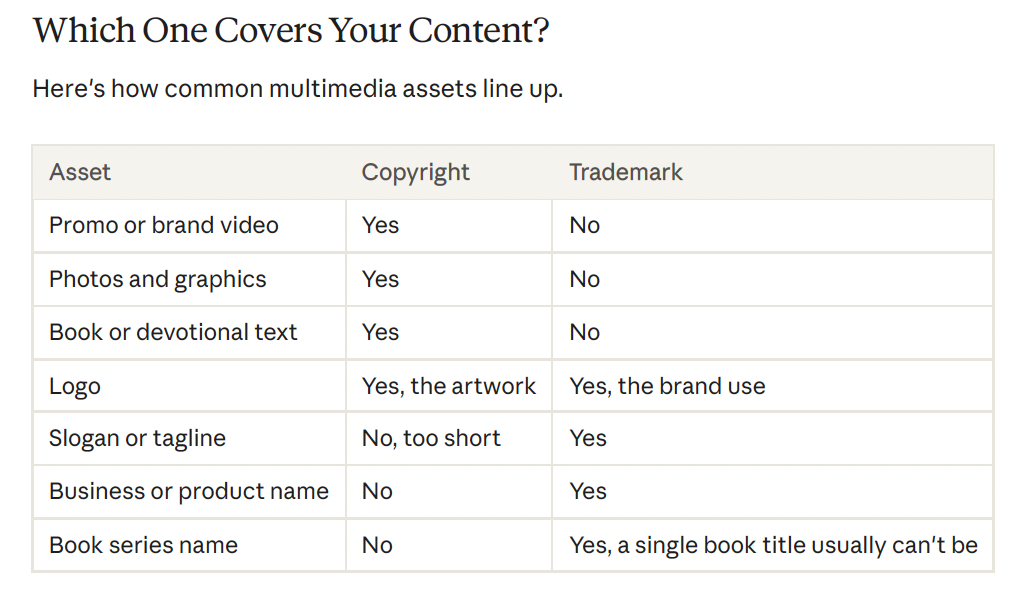
The logo is where people get tripped up. Copyright protects the drawing itself. Trademark protects how you use it to identify your business. Smart brands lock down both.
FIVE Moves to Protect Your Brand This Week
Get ownership in writing. Hired a designer or videographer? By default, the creator owns the copyright unless a signed agreement transfers it. Make sure your contract says when the rights become yours.
Add ™ to your logo and slogan today. It costs nothing and puts the world on notice.
Search before you name anything. Check the free USPTO database at tmsearch.uspto.gov before you print a single business card. Rebranding costs far more than a 10-minute search.
Register your high-value work. Books, courses, and signature videos earn their $65 filing fee many times over if someone steals them.
Check every license. Fonts, music, stock photos, and templates all need commercial licenses, especially on print-on-demand products you sell.
Build It. Own It. Get Noticed!
Here's the short version. Copyright protects what you make. Trademark protects who you are. Your brand needs both.
At Donafren Multimedia, every logo, video, and graphic we deliver comes with clear ownership terms. You get the work and the rights to use it with confidence. Ready to build a brand that's bold, memorable, and fully yours? Let's talk.
This article is for general information only and isn't legal advice. For registrations, disputes, or international protection, talk with a licensed intellectual property attorney.
